My Administration’s Focus
Protecting Our Children and Preserving Our Communities
Expose and stop predators. Crimes against children are far more common than most realize—we must face this reality head-on, not simply react after harm is done. We will make child safety a top priority through proactive prevention, swift justice, and unified partnerships.
Strengthen our dedicated efforts. Davis County deserves an increased effort to identify, prevent, and prosecute those who target and exploit our kids.
Relentless Focus on Crime
Invest in people and leadership. A strong Sheriff’s Office begins with crime-focused, well-trained, and ethically driven deputies who serve with passion, integrity, and pride.
Zero tolerance for criminals. Davis County will not be a refuge for offenders, traffickers, or predators of any kind. We will find them. We will investigate them. And we will deliver them for prosecution.
Balance prevention and accountability. We’ll strengthen enforcement while addressing root causes through education, collaboration, early intervention, and community trust.
Upholding Constitutional Rights and Individual Freedoms
Protect individual liberties—speech, privacy, due process, and the right to bear arms—without compromise.
Serve with transparency and fairness, accountable to the people, the Constitution of the United States, and the Constitution of Utah.
Freedom and justice go hand-in-hand. True peace is built on liberty, not control—and law enforcement must defend both.
Embracing Technology and Combating Cybercrime
Fiscal and ethical accountability. Every tool, program, and dollar spent must serve freedom, safety, and the public good.
Use technology responsibly. Innovation will enhance safety, efficiency, justice, and transparency while never replacing human judgment or infringe on rights.
Lead locally on digital threats. We’ll build real capability to investigate cybercrime and protect residents from online exploitation and fraud – the new crime of our generation.
Building Strong Partnerships to Serve Davis County
Leadership for the Sheriff’s Office and Our County. Committed to creating trusted leadership within the Sheriff’s Office by hiring & promoting professionals who live right here in Davis County—local agency partners who know our communities and are dedicated to serving them with integrity.
Collaboration creates strength. The Sheriff’s Office will work closely with local, county, and state leaders & federal partners to protect our communities and exercise fiscal responsibility.
Partnership through trust. From schools and nonprofits to public safety and government, unity is key to lasting and effective improvement.
Professional Experience
Proven Public Safety Leader
With over a decade of experience as a law enforcement officer & supervisor, paramedic, firefighter, and tactical operator, I have dedicated my career to protecting lives and strengthening public trust. I’ve led critical incident responses, coordinated multi-agency operations, and managed taxpayer resources responsibly — always putting community safety first.
Seasoned Law Enforcement Professional
With leadership roles in Internal Affairs, SWAT, Criminal Investigations, Training, Policy, and Emergency Response; I’ve worked to ensure accountability, transparency, and operational excellence within the Sheriff’s Office. My focus has always been on raising professional standards, supporting deputies, combating crime, process improvements, and strengthening public confidence.
Commisioned Military Officer and Veteran
Holding a Top Secret/SCI Clearance and international experience in NATO and Middle East operations, I have led intelligence teams in complex environments to deliver actionable insights and mission-critical assessments. As a Captain in the Utah Air National Guard, I’ve combined military discipline with strategic leadership to safeguard U.S. interests and support global security operations.
Originally enlisting into the Army as a PFC (E3) within the Military Police Corps I went on to transfer to the Air Force Security Forces where I rose to TSgt (E6) deploying as the Non-Commissioned Officer In-Charge of base wide small arms and ammunition used to defend a US military instillation of 1,200+ personnel on a 12 month activation.
Dedicated Trainer and Mentor
Responsible for developing law enforcement officers, medics, airmen, and soldiers through evidence-based instruction in leadership, tactics, and crisis response; I take pride in preparing others to lead. My commitment to professional training ensures that every team member serves with confidence, integrity, and readiness when the community needs them most.
Balanced and Service-Driven Leadership Style
Shaped by combined experience in policing, firefighting, EMS, military police, and military intelligence, my leadership is grounded in integrity, discipline, and duty to both our nation and our community. I lead with balance, empathy, and purpose—guided by a lifelong commitment to service and to strengthening the trust between law enforcement and the people we serve.
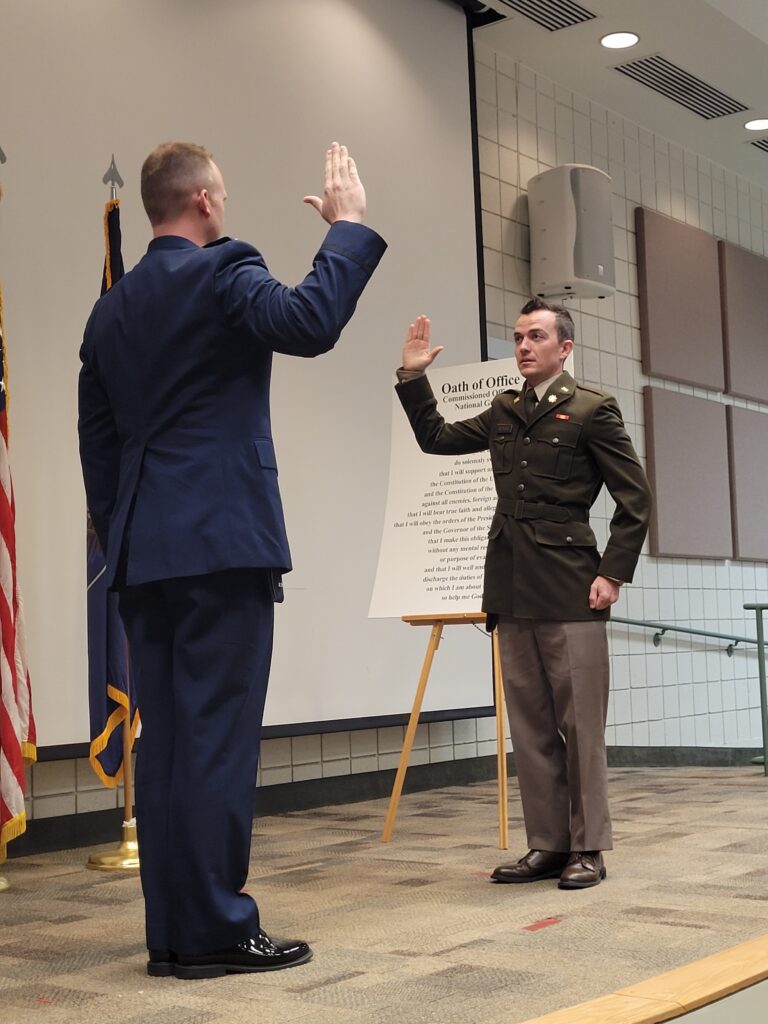
History of Taking an Oath of Office
“I do solemnly swear that I will support, obey, and defend the Constitution of the United States and the Constitution of the State of Utah, and that I will discharge the duties of my office with fidelity.”
An Oath of Office is more than a formality — it’s a public pledge to uphold the duties and standards of the position. By taking the oath, officials commit to act truthfully, faithfully, and in accordance with the law and moral responsibility. Traditionally invoking God or a sacred authority, an oath binds the taker to both legal and ethical obligations; those who prefer may instead “affirm” without religious reference. Oaths of office date back to ancient Rome and have long been central to representative government. The U.S. Constitution requires oaths or affirmations for federal and state officials, and nearly all public offices follow this tradition. For an oath to be valid, it must be administered by an authorized public official and may be spoken or, when required by law, written and signed
Historical Significance of The Sheriff
The Office of Sheriff is the oldest continuous law enforcement institution in history, tracing back to 9th-century England, where the “shire-reeve” was responsible for maintaining order, collecting taxes, and enforcing the king’s laws. Though the English role later became ceremonial, the office took on new life in America.
The first American sheriff was appointed in Virginia in 1634, and by 1652, the office became elective—anchoring it in democratic accountability. Early sheriffs upheld law and order on the frontier, enforced court orders, managed jails, and collected taxes. Many became legendary figures, embodying justice and public service.
By the late 1700s, elected sheriffs were written into state constitutions, a tradition that continues today—nearly 98% of U.S. sheriffs are elected by local citizens.
What makes the office unique is its independence and direct accountability to the people. Unlike appointed officials or police chiefs, sheriffs answer only to the Constitution, the law, and their voters—not to political or administrative authorities. This independence ensures the sheriff remains the people’s representative in law enforcement.
To preserve this vital institution, sheriffs must honor their history, serve with integrity, resist undue influence, and remain faithful to both moral and legal duties. As long as they do, the Office of Sheriff will endure as a uniquely American symbol of justice and accountability.